

Key-takeaway
This report focuses on financial solutions for inexpensive cellphones priced at around $100. It focuses on finance platforms that provide people with access to low-cost cellphones through credit payment and installment agreements.
The platforms use phone-locking technologies to ensure payment compliance while also encouraging digital inclusion in emerging economies like Kenya.
Overview of Smartphone Financing in Kenya
According to the Communications Authority of Kenya (CAK), smartphone penetration in Kenya has increased significantly over the past decade, with smartphones accounting for 72.6% of mobile devices used by Kenyans.
Despite the high adoption rate, device costs remain an obstacle for many low-income Kenyans. This affordability gap has created an investment opportunity for fintech firms that have established smartphone financing models, enabling consumers to purchase low-cost phones and pay in installments.
The smartphone financing models are part of a broader trend toward Buy Now, Pay Later (BNPL) and microloan-based device financing. These schemes aim to democratize smartphone access by allowing payments to be spread out in manageable installments for individuals who cannot afford a one-time upfront payment.
Rise of device credit models
Affordable smartphone financing in Kenya was driven by the success of Safaricom’s M-Kopa financing model, which focused on solar energy systems. This model inspired Safaricom in 2020 to launch Lipa Mdogo Mdogo, while also encouraging other fintech companies and online retailers to enter this market.
The new players offered flexible Buy Now, Pay Later (BNPL) options that let customers finance phones and other electronics. These services typically require a deposit, a national ID, and proof of income (such as M-Pesa statements), with repayment periods ranging from 2 to 12 months.
Platforms such as Lipa Later, watu simu, and Aspira, have established themselves in the market, creating a structure for smartphone accessibility that has grown in popularity.
Market dynamics and target demographic
The smartphone market in Kenya is very competitive, with an ever-increasing number of participants. Because of the technology similarities, the participants share a common denominator: they rely on mobile money (particularly M-Pesa), digital credit scoring, and smartphone locking software as compliance strategies.
The main target audience is lower-income users in rural and peri-urban areas. M-Kopa and Safaricom particularly serve this market and enjoy a comfortable lead due to their market share.
Some platforms, such as Lipa Later and Aspira, cater to more urban, salaried customers looking for premium or mid-range devices, whereas PayJoy focuses on users who can afford $100 smartphones but need quick, flexible credit access with minimal paperwork.
Comparative analysis of phone deals
The device credit space in Kenya has seen an increasing number of players, leading to greater competition for clients. Access requirements, repayment flexibility, technical enforcement methods, and customer support frameworks vary among these players.
In this section, PayJoy is contrasted with four major competitors that offer installment-based access to entry-level smartphones ($100 price range): Lipa Mdogo Mdogo, M-Kopa, Lipa Later, and Aspira.
| Feature | Onfon Media | Lipa Mdogo Mdogo (Safaricom) | M-Kopa | Aspira | Watu simu |
| Target Price Range | ~$50–120 | ~$40–100 | ~$60–130 | ~$100+ | ~$70–200+ |
| Eligibility | National ID, phone number, selfie | Safaricom user for 1+ year | National ID, mobile money history | ID, bank/M-Pesa statement | An original National IDNo active loans with WatuBe at least 18 years oldAn active mobile money transaction lineNext of kin contact details (the contact must be available/online for verification)A minimum down payment amount for the selected device |
| Initial Deposit | KES 1,500–3,000 | KES 1,000 | KES 3,500–5,000 | 10–30% | KES 3,300–10,000+ |
| Repayment Term | 3–12 months | Daily (KES 20), for 9 months | Daily (KES 60–70), for 1 year | 3–12 months | Weekly, for 1 year |
| Interest or Fees | No interest, but includes a service fee in total cost | No interest | No interest, late lock risk | May include interest | Includes interest/fees in total cost |
| Enforcement | Device-lock via proprietary software | Device-lock (Google lock) | Device-lock (custom firmware) | Legal action, credit blacklisting | Device-lock (custom software) |
| Channel | Partner mobile phone shops & online platform | Safaricom Shops/USSD | M-Kopa shops/Safaricom | Online retailers | Select partner phone shops |
| Phone Brands | TECNO, Infinix, Samsung, Nokia | Mainly Itel, TECNO | Nokia, Samsung, TECNO | Multiple brands | Primarily Samsung |
| Flexibility & Approval Speed | Fast, digital approval (often within minutes) | Automated USSD eligibility | Moderate, often 24–48 hrs | Moderate | Very fast, in-store approval (under 30 mins) |
All the players offer similar products to their customers, and ultimately, what differentiates them is the price point, documentation requirements, and retail distribution points. Consumers generally select their preferred platforms depending on the following:
- Network preference.
- Location.
- Deposit affordability.
- Comfort with device lock enforcement.
Risks and challenges of phone financing models in Kenya
With such strong demand, smartphone penetration, and promises of digital financial inclusion, it is natural to assume that there are few risks to investing in the market, but this is not necessarily true.
Phone financing fintech platforms face numerous challenges and obstacles from both the supplier and customer standpoints. They include the following:
- Over-indebtedness and Digital Credit Risk: FSD Kenya’s 2021 study found that over half of digital borrowers have defaulted on at least one loan. The addition of smartphone credit financing may increase vulnerability and raise the risk of default.
- Repossession through device locking enforcement: Since device locking technology is a standard payment enforcement method, many clients may struggle to use their phone for other services, leading to default and potential repossession or device loss.
- Lack of consumer awareness: Due to limited information about smartphone credit finance, some consumers have signed up for financing without fully understanding the repayment terms, interest rates, or penalties. Consumer education is still a gap in the ecosystem.
- Data privacy and awareness: Despite the existence of a Data Protection Act, enforcement has proven difficult, as platforms continue to collect sensitive user data to assess creditworthiness or enforce payment obligations, raising privacy concerns.
- Legal and regulatory gap: Smartphone credit financing lacks specific regulations in Kenya. It remains in the regulatory gray zone, potentially exposing consumers to exploitation.
- Limited device lifespan and quality: Smartphones in the $100 price range are typically low-end devices with limited lifespans. This lowers the value proposition over the long run and could lead to discontent.
- Rural access and connectivity issues: Hard-to-reach areas with underdeveloped infrastructure lack access to retailers and are unaware of the service’s existence due to inadequate advertising.
Unit economics and profitability pathways
The long-term success of a device financier hinges on mastering its unit economics. While the high markups on devices seem lucrative, the model is capital-intensive and fraught with costs that can quickly erode profitability if not managed with extreme discipline.
Deconstructing the Costs:
- Cost of Goods Sold (COGS): For a sub-$100 device, this is the most significant initial cash outlay. M-KOPA’s local assembly operations give it an important potential advantage in managing this cost by reducing import duties and logistics expenses, and potentially negotiating better terms for components. Players like PayJoy, who partner with distributors, are more exposed to these variables.
- Cost of Capital: Device financiers are lending businesses; they need a large pool of capital to fund their loan book. The interest rate on this capital is a critical determinant of profitability.
- Customer Acquisition Cost (CAC): This includes all marketing expenses and, crucially, sales commissions. M-KOPA’s model relies on a vast network of over 14,000 paid sales agents, representing a high variable cost. PayJoy’s B2B2C model shifts some of this burden to its retail partners, potentially resulting in lower direct CAC.
- Operational Costs (OpEx): These are the ongoing costs of running the business, including customer service centers, technology maintenance, software development, and the increasingly high costs of regulatory compliance and licensing.
- Cost of Default: This is the ultimate risk variable. It represents the net loss on loans that are never fully repaid. Even with locking technology, there is a cost associated with a defaulted device (depreciation, refurbishment, etc.).
Deconstructing the Revenue:
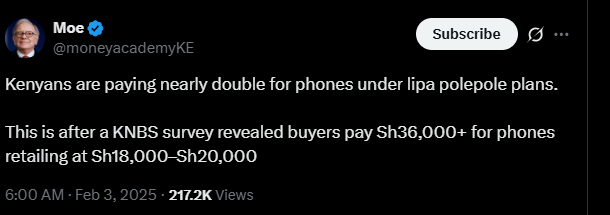
- Financing Margin: The primary source of revenue is the difference between the total amount of installments the customer pays and the phone’s initial cash price. While companies avoid using the term “interest,” the effective annual percentage rates (APRs) are incredibly high. User reports of the final cost being nearly double the retail price suggest effective APRs well above 100%. This high margin is necessary to cover the high costs and risks of serving this segment.
- Value-Added Services (The Ecosystem Play): For M-KOPA, a significant and growing portion of revenue and profit comes from cross-selling other financial products. Its cash loans, offered to customers with a good repayment history, carry monthly interest rates of 5.6% to 9.1%, translating to an APR of 67% to 109%. This is where the long-term value of the customer relationship is truly captured.
- Data Revenue (The MNO Play): For Safaricom, a key component of the return on investment is not the financing margin itself, but the incremental revenue generated by customers’ increased data consumption after upgrading to a 4G smartphone.
The highly effective interest rates charged by players like M-KOPA represent a systemic market vulnerability. While currently tolerated by consumers due to a lack of alternatives, this high cost of credit creates a significant opening for a disruptor.
As the market matures and regulatory pressure for transparency increases, price competition is inevitable. A company that can leverage a lower cost of capital and superior operational efficiency to offer a genuinely lower total cost of ownership could rapidly capture market share.
Ultimately, the most sustainable path to profitability lies in graduating customers from the initial, relatively low-margin smartphone loan to a broader suite of higher-margin financial products.
The smartphone is the on-ramp to the financial superhighway. A customer who successfully pays off a phone is a de-risked and data-rich prospect for a revolving credit line, a cash loan, or an insurance product.
Therefore, an investor should value these companies not on the volume of phones sold, but on their ability to build and monetize a high-quality, revolving loan book and maximize customer lifetime value (LTV).
Bottom line
The future of the Kenyan device financing market, and indeed, fintech for the underbanked across Africa, lies in the evolution from single-product asset financing to building holistic, long-term financial relationships. The initial smartphone loan is the critical first step, the on-ramp that provides access, data, and a foundation of trust.
The ultimate winner in this market will be the company that most effectively leverages this on-ramp to guide customers toward a broader suite of fair, transparent, and affordable financial services, such as revolving credit, insurance, and savings products. PayJoy’s global strategy, which already includes these follow-on products in its more mature markets, is perfectly aligned with this vision. Its success in Kenya will hinge on its ability to flawlessly execute this playbook while simultaneously fending off M-KOPA, a deeply entrenched and strategically savvy local champion.
An investment in PayJoy is, therefore, a bet on a specific theory of the market: that in the long run, superior technology, a more sustainable financial model, and a brand built on transparency and trust can triumph over a competitor’s advantages in distribution and ecosystem breadth. It is a bet that as the market matures and consumers become more sophisticated, they will choose the provider that offers them the best value and treats them with the most respect.